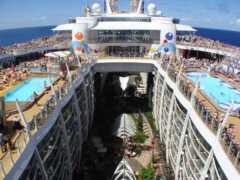
How modern cruise ships, complete with theatres, neighbourhoods, and pools, manage to float effortlessly across the ocean.
Royal Caribbean operates the largest passenger ships ever built, but Carnival, Costa, MSC, AIDA, P&O, Princess and others also have in their fleets huge vessels that function like small cities at sea.
They carry thousands of passengers and crew and feature everything from theatres and waterparks to ice rinks and zip lines, along with dozens of bars, cafes, lounges, and restaurants. But beneath the scale and spectacle lies a straightforward question: how do ships of this size float?
The answer is found in a combination of physics and careful engineering that begins with a principle first described more than two thousand years ago.
[embedded content]
Archimedes’ principle states that when an object is placed in water, it pushes aside — or displaces — a volume of water equal to its own weight. The water, in turn, pushes back with an upward force called buoyancy. If that buoyant force is equal to or greater than the object’s weight, the object floats.
Cruise ships are built primarily from steel, which is denser than water. However, the overall structure of the ship includes a large amount of empty space filled with air — wide promenades, large atriums, cabins, and open decks. This design lowers the vessel’s average density, allowing it to displace enough water to stay afloat. In simple terms, the ship as a whole is less dense than the water it sits in.
The next factor is the shape of the hull. Cruise ships are designed with broad, hollow hulls that spread weight across a large surface area. This allows them to push aside more water and increases the buoyant force keeping them above the surface, which is why modern cruise ships have a shallow draft compared to ocean liners of old.
The placement of heavy equipment also matters. Engines, machinery, and fuel tanks are located deep within the lower decks, below the waterline. Lighter structures — such as passenger cabins, restaurants, and entertainment venues — are placed higher up. This arrangement creates a low centre of gravity, which keeps the ship upright and stable even in rough conditions.
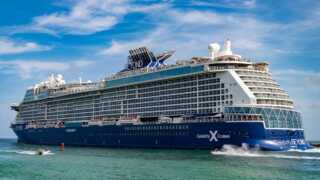
Star of the Seas
Modern cruise ships are also equipped with stabilising fins that can extend or retract as needed. These underwater fins act like wings, countering the side-to-side rolling motion caused by waves. Together with the ship’s hull design, they ensure that movement is reduced to a level where daily operations — including dining and performances — can continue without major disruption.
Ship stability isn’t static; it’s constantly managed. Bridge officers monitor sea conditions and can adjust the ship’s heading, speed, and stabilisers to maintain balance. This coordination ensures both passenger comfort and the safe operation of onboard systems, although it is not essential to the stability of the vessel, as cruise ships can roll or heel over to a surprising degree before capsizing.
This level of precision is more significant to the operations of the entertainment team. Theatre schedules are sometimes planned around the ship’s movement and the weather patterns its sailing in. The navigation team can modify the course slightly to ensure stability during performances, demonstrating how operational decisions link directly to physical principles.
The ability of such large ships to float is therefore a result of applying long-understood scientific laws to complex engineering. Archimedes’ principle, combined with low-density design, balanced weight distribution, and constant operational management, allows these vessels to remain stable and buoyant.
When viewed in this light, Royal Caribbean’s ships are not just cruise liners but large-scale demonstrations of basic physics applied with modern precision, floating structures that operate safely and efficiently thanks to the same principles that have guided shipbuilders for centuries.
Related
Appeared first on: Cruisearabiaonline.com